

 Language
 Language
Using himalayan salt blocks
Himalayan Salt Slabs, Blocks, Plates and Bricks are nature's cook top and serving platter in one, offering many creative culinary uses while delivering the benefits of natural, pure salt with no chemicals or additives. Heat your Himalayan pink salt slab, plate, or brick to high temperatures and sear thinly sliced meats, fish, vegetables, seafood and other quick-cooking foods (see recipes below!). Or, chill it for use in serving sushi, appetizers, cold meats and cheeses, fresh fruit and vegetables, and even cold desserts.
Himalayan pink salt blocks, plates, and bricks are harvested from deep within the ancient Himalayan mountain range of Pakistan. There, they have remained protected from pollution and impurities for centuries, making this what many consider the purest, cleanest salt in the world. The salt is mined as large, meteor-like boulders and later sliced into slabs, blocks, bricks and plates as well as sculpted into bowls.
Because Himalayan salt blocks are a natural product, the threshold for high temperatures and pressure may vary, as will the physical characteristics and inclusions which give your salt slab a one-of-a-kind appearance. You'll find that Himalayan salt slabs, plates, and bricks make for an intriguing presentation of both hot and cold foods for your home, restaurant, spa or catering facility. All of our Himalayan salt products are Gourmet Food Grade and the very highest quality Himalayan salt available.
Himalayan Salt Block Cooking
Himalayan salt blocks aren't your typical cookware! They're incredibly dense and conduct heat efficiently but slowly, which is why the slab retains heat so well and seasons food evenly. Slabs can crack if they are heated (or chilled) too quickly as any moisture trapped inside expands, so it's best to follow these usage suggestions and care instructions to get optimum life from your salt block.
For Serving
Himalayan salt slabs are perfect to use as serving platters. The slab can be chilled in the refrigerator for serving items such as sushi or cheese, or even frozen in the freezer, providing a new way to present cold desserts, even sorbet! Moist foods will pick up more salty flavor, while their denser and drier counterparts will be presented beautifully and imaginatively.
How will the Himalayan salt slab affect different types of foods
Foods placed on a Himalayan crystal salt slab take on a light, clean, naturally salty flavor while absorbing minerals necessary for good health and longevity. When placed on the Himalayan salt block for an extended period of time, thinly sliced fish such as salmon, tuna and whitefish will begin to cure from the salt, which acts as a preservative. Generally, a natural salt slab will add a hint of salty taste to moist or wet foods, but will have no effect on dry foods. For example, if you use your salt slab to serve cheese and crackers, it will lend a bit of saltiness to the cheese but the taste of the crackers will remain the same.
How to cure foods using a Himalayan salt block
Himalayan salt blocks can be used to cure thinly sliced meats, fish and seafood. Simply chill your natural salt slab in the refrigerator for several hours, then place thin strips of ahi tuna or beef carpaccio directly onto the salt slab and observe as the curing process slowly takes place. The irregular shades of pink and varying textures of this 100% pure wonder of nature make for intriguing conversation and an attractive, natural serving platter for all your favorite foods.
For Cooking
Imagine cooking your food on a 250 million-year-old slab of pure, crystallized mineral salt. What better way to bring the clean taste and nutritional benefits of pure mineral salt to your table? Himalayan pink salt slabs can be heated to as high as 450 degrees Fahrenheit and used to lightly sear all sorts of delicious foods. When the cooking is through, your mineral salt slab will slowly return to room temperature for future use as a cold serving plate.
How to sear meat, fish and vegetables with your Himalayan salt slab
Your Himalayan salt slab can be slow-heated, either in the oven or over a gas flame or electric burner, for searing or lightly grilling meat, fish or vegetables. Note that when subjected to high temperatures, the salt slab will turn white in some spots. This is normal. As it cools, your Himalayan salt slab will regain more of its original coloring. Because of the potential for this slight alteration in appearance from heat, you may wish to preserve one slab for display and/or serving, and one slab for cooking if this is a concern. When cooking with your salt slab, ensure that it is completely dry prior to applying any heat, as lingering moisture inside the slab may expand and cause damage to the slab. Typically the dry time should be at least 24 hours since the slab's last contact with any moisture.
Himalayan salt slab with seared beef ribeye
To heat in the oven: Place your dry salt slab into a cold oven and turn the heat to 250 degrees Fahrenheit. When the oven has reached 250 degrees, remove the salt slab and let cool for about 30 minutes. Then return it to the oven and set the temperature for 400 to 450 degrees Fahrenheit. The heat will distribute slowly and evenly throughout.
To heat using a gas burner: Place your dry Himalayan salt slab over a low gas flame for 15 minutes. If you desire a higher temperature, heat for an additional 15 minutes on a medium-high gas flame.
To heat on an electric stove: Use a metal spacer or wok ring to prevent the salt slab from making direct contact with the heating element. Follow instructions for gas heating.
Once you've thoroughly heated your Himalayan salt slab, you're ready to sear your meat, fish and/or vegetables. Place the thoroughly heated salt plate on a heatproof surface. Lightly toss your meat, fish or vegetables in oil, spices and herbs. You may also wish to lightly drizzle the salt cooking surface with olive oil, adjusting to your desired level of saltiness (less oil will cause more salting of your food and vice versa). Place directly onto the heated salt slab, then cook to desired doneness, stirring and moving around the salt plate as you would any other grilling surface. Your salt block will retain the heated temperature for 20 to 30 minutes. Avoid making direct contact with the salt block for some time after cooking the meal, as it will take several hours to cool completely.

Himalayan Salt Block Cleaning & Care
To clean your Himalayan salt block, wipe with a clean, damp cloth or paper towel and remove any remaining food bits. Avoid running your natural salt block under water or submerging in water, as any remaining moisture in the salt slab can cause breakage upon heating. Be sure to let your salt slab dry for at least 24 hours after exposure to any moisture. There is no need to use soap or detergent on your Himalayan salt slab, as it is naturally anti-fungal and anti-microbial. You may wish to freshen your salt block with a bit of lemon juice from time to time.
Note that the appearance of your Himalayan salt slab will change over time. The more varieties of foods you cook and serve on your salt plate, the more likely the surface will acquire various, interesting new colors and shades. This merely adds to the irregular beauty of the Himalayan salt slab. Your salt block may also develop small fissures and cracks over time; this is typical with regular use. When the salt block finally gets too small for cooking or serving on, it will be a perfect size to grate over your food, break up for making soup, or even to throw into your tub for a detoxifying salt bath.

What are the differences between pink and white salt bricks
From a health standpoint, pink and white both pack 84 naturally occurring minerals, and both are rich in negative ions, which are wonderful for combatting overexposure to positive ions and offer great health benefits such as stress reduction, energy increase and more. Varying levels of minerals in the salt create differences in pattern and color, ranging from pale white, to pink, to orange, to red.
The deepness of the salt's color largely depends on the amount of iron oxide running through it. White Himalayan salt (at a premium because it is the rarest variety) is the freest from impurities. In comparison, added minerals give pink Himalayan salt its rosy glow.

How To Clean and Store a Himalayan Salt Block
When it comes to HimalaHow To Clean and Store a Himalayan Salt Block.
When it comes to Himalayan salt blocks, cleaning is a very delicate process. First and foremost, don't use soap, and don't put it in your dishwasher!
Allow it to cool first, then wipe it down softly with a moist sponge (not soaking wet one), scrub with a brush or scourer if need be, and pat dry immediately. Then allow to air-dry for as long as needed. The antimicrobial properties of salt keep the block clean with no need for soap. Keep the block as dry as possible and never submerge in water. You don't want the salt to dissolve!
Once clean and dry, store it somewhere cool and dry. We suggest you wrap the block in plastic wrap to prevent moisture pooling.
A Himalayan salt block will give you a new, creative way of cooking. Not only will it make your food sing, it will be sure to impress your family and guests too. Have a look at our range here and read more about using your salt block here. The creative options for salt block cooking are practically endless, so get busy!yan salt blocks, cleaning is a very delicate process. First and foremost, don't use soap, and don't put it in your dishwasher!
Allow it to cool first, then wipe it down softly with a moist sponge (not soaking wet one), scrub with a brush or scourer if need be, and pat dry immediately. Then allow to air-dry for as long as needed. The antimicrobial properties of salt keep the block clean with no need for soap. Keep the block as dry as possible and never submerge in water. You don't want the salt to dissolve!
Once clean and dry, store it somewhere cool and dry. We suggest you wrap the block in plastic wrap to prevent moisture pooling.
A Himalayan salt block will give you a new, creative way of cooking. Not only will it make your food sing, it will be sure to impress your family and guests too.
More and more people are reaching for salt blocks in the kitchen, and for good reason. Not only do they look beautiful (and are sure to impress your dinner guests), cooking with a Himalayan salt block has a range of benefits.
Fantastic heat resistance and distribution
Salt blocks are extremely resistant to heat, which not only makes them brilliant for both high- and low-temperature cooking, but also means the heat is distributed more evenly, which is exactly what you want from any cooking surface.
01
Imparts healthy minerals to food
By cooking on a Himalayan salt block, your food will be infused with the 80+ minerals found in the salt. Not only are these healthy, they will also impart a more complex flavour profile to your food.
02
A delicate, yet full-bodied salt flavour
The low porosity of salt blocks mean they retain very little moisture. These two factors mean that using a salt block slowly gives your food a delicate salt flavour, rather than overpowering it.
03
Retains heat for longer
The crystalline structure of salt blocks ensure they retain heat for longer, which is excellent for resting meats, or for serving food and keeping it warm. Just be careful when carrying your hot block!
04
A natural anti-microbial surface
The low porosity and moisture retention of salt blocks mean they are a naturally anti-microbial surface that discourages bacterial growth, which makes it an excellent option for serving!
05
Read along to learn how to use the pink salt tiles to reap the maximum benefits.


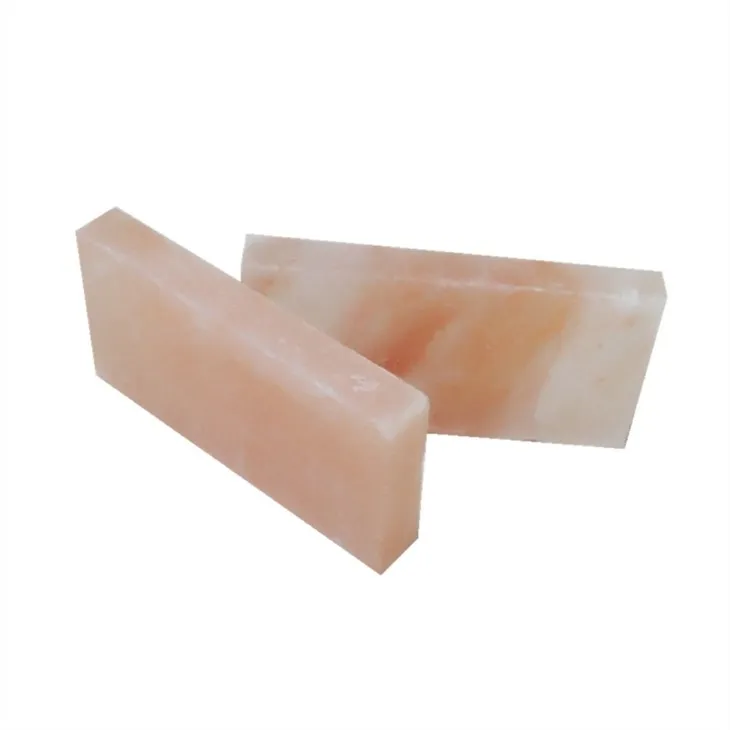
Himalayan Salt Tiles For Walls
You have the following options to construct a Himalayan salt tile wall.
Existing wall and the floor – Before constructing the Himalayan salt wall, you should ensure that the editing walls can endure and suppress the salt walls' weight.
Freestanding pink salt walls – You can also construct a wall comprising Himalayan salt bricks independently without any support. However, in such a case, the floor should be robust enough to bear the heavy weight of the salt bricks. For example, you can have salt partition walls in the master bedroom or open spaces.
Backlighting – Installing backlighting on the salt walls serves a two-fold purpose. One, it enhances the overall aesthetics, and second, it offers the desired heat to the salt to support the optimal ionization effect. You can use the track, rope, and tube lighting to backlit the salt wall.
Himalayan Salt Floor Tiles
Placing the Himalayan salt tiles on the floor offers a detox effect. When your toes come in contact with the salt tile, it pulls the toxins from your feet in the form of sweat. Similarly, your feet absorb the 84 minerals present in the Himalayan salt to offer the following benefits:
Foot detoxification
Alleviate tiredness
Lessen aching due to overexertion
Himalayan Salt Tiles For Salt Rooms
You can create beautiful and functional salt rooms by installing salt tiles in your homes. You can replicate the pink salt caves by using these salt tiles and bricks. You can even use big rectangular salt tiles for building a salt room.
Sitting in the salt room allows you to relax as you inhale the salty air. In addition, the therapeutic effects of this dry salt therapy help treat airway problems.
Tiles for Salt Caves
Spending time in natural salt caves for treating respiratory issues is an old method. Now, you can use different sizes and shapes of salt tiles to create salt caves in your basement. Also, you can place salt grains or salt chunks within the cave to enhance the negative ions' concentration within the cave.
Salt Tiles For Cooking/Grilling
You will be amazed to know that these beautiful-looking salt tiles can also be used to cook and grill various kinds of dishes. Yes, you heard it right. These amazing salt tiles can be used for cooking meat, veggies, seafood, and other foods. You just need to follow the instructions for heating and cleaning these tiles when using them for cooking foods. These salt cooking blocks are great for outdoor grilling.
Himalayan Salt Serving Tiles
Not just for cooking, these Himalayan salt tiles can also be used as serving platters. Unlike other serving plates, these salt tiles are all-natural. You can serve both hot and cold foods on these salt blocks.
When ready to use, it is important to heat the salt block correctly. Heating it is slightly more complicated than just turning on a burner and cooking in a pan. It isn't difficult though and with a little prep, a salt block becomes a simple way to cook.
How to Heat a Salt Block on the Stove
Make sure it is completely clean and dry and that it has been at least 24 hours since it was wet.
Place the salt block over a gas burner (or over an electric range, but place a metal ring or grate of some kind in between to allow air to flow between).
Turn the heat on low and set a timer for 15-20 minutes (depending on size- larger blocks take longer).
Increase the heat to medium and leave for another 15-20 minutes.
Turn up again to medium/high for another 10-15 minutes.
If you have one, use a laser thermometer to make sure the block is around 500 degrees. Don't have one Splatter a few drops of water on the salt and make sure they dance and evaporate immediately. Be careful not to touch it (seems obvious, but very important as it will maintain heat for a long time).
At this point it is ready to use. See instructions below for cooking instructions for various foods.
As a group, we do. Putting Himalayan pink salt bricks in your living room will make it feel warm and cozy. The eyes feel a lot better when they see the faint orange light. Put regular salt bricks on your wooden deck, no matter how big or small your living room is. To make the orange shine stand out, add white shades.
It will make the whole room look bigger and airier. This setting will make the uplifting tones sound even better, and everyone will be amazed by how good it is.
Try not to go for the cruel lights when you're reading books to help you understand. Likewise, it will make you disturbed. If you're a book lover and want to read in peace, you can do so with a cup of tea, your favorite book, and a Himalayan Normal pink Salt Brick in a quiet corner.
Trust me, the light shimmer and quiet base will take you to another world. So, put a Himalayan brick next to the area where you understand and enjoy!

Our company has more than 7000 square meters product processing area . We have two departments: raw material processing department and mineral products deep processing Department.



We're professional himalayan salt bricks manufacturers and suppliers in China, specialized in providing high quality customized service. We warmly welcome you to wholesale high-grade himalayan salt bricks in stock here from our factory.
Kaolin Clay Lump For Cermaic, Slingshot Mud Balls, massage ball salt lamp(0/10)
